 Karak
Karak restaking requires a compatible network, asset and vault combination, while on-chain records reveal deposit and withdrawal outcomes.
Karak restaking problems are easiest to isolate by matching the selected network, asset contract, vault and recipient before reading the transaction result. A wallet prompt only proves that a request was prepared. The receipt, vault events, share balance and withdrawal record show how far the action actually progressed.
What Does Each Transaction Status Mean?
A missing, pending, reverted or successful transaction points to a different diagnostic branch. If the wallet produced no transaction hash, verify the sender nonce and transaction history before treating the request as unsubmitted. Reconnecting the wallet may help, but first confirm that it is using the intended account and network.
A pending hash means the network has seen the transaction without finalizing it. The relevant evidence is the sender nonce, submitted fee settings and any replacement transaction. Repeating the application action immediately can create a second request rather than accelerate the first one.
A reverted receipt confirms that execution reached the contract and failed atomically. No deposit or withdrawal state should be inferred from a failed call. Decode the revert when possible, then inspect allowance, balance, vault state, timing and pause conditions before changing any input.
A successful receipt proves that the transaction did not revert, but it does not guarantee that a portfolio interface has indexed the result. Deposit events, share-token transfers and contract reads take precedence over a stale display. The recipient field also matters because minted shares can belong to an address other than the connected wallet.
Compatibility Before Any Transaction
Compatibility requires one exact network, asset contract and vault combination. A familiar token symbol is insufficient because symbols can recur across networks or represent different contracts. The wallet also needs the network’s native gas asset even when the deposited asset is an ERC-20 token.
Network and Contract Identity
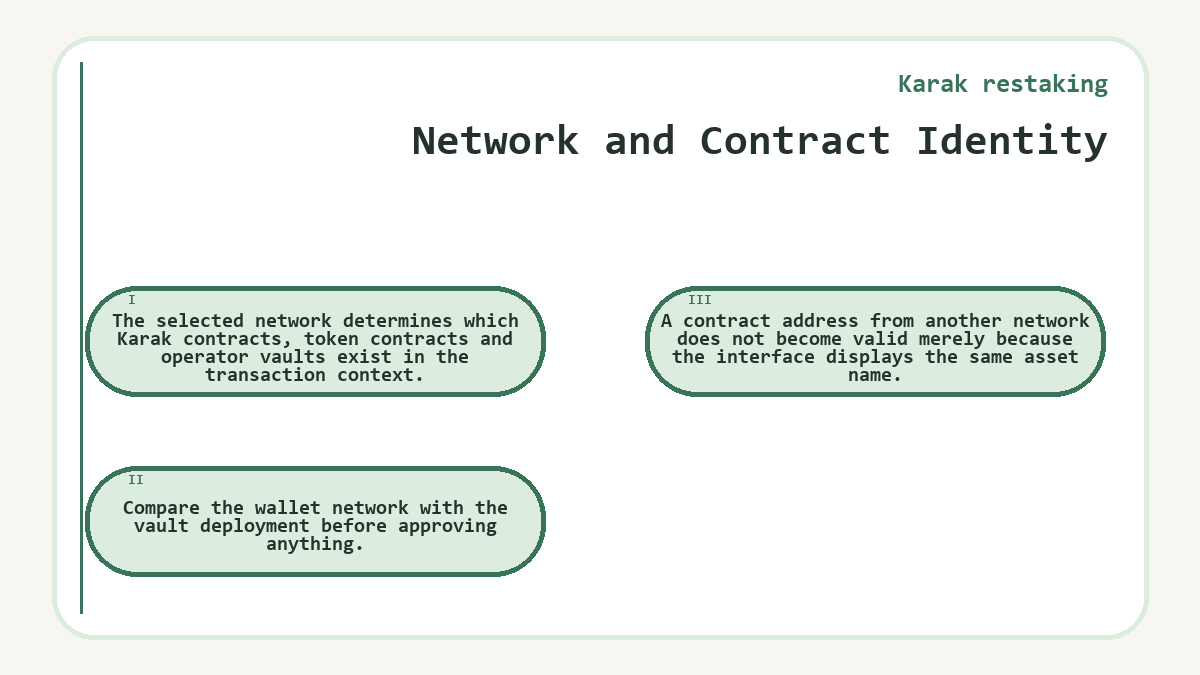
The selected network determines which Karak contracts, token contracts and operator vaults exist in the transaction context. Compare the wallet network with the vault deployment before approving anything. A contract address from another network does not become valid merely because the interface displays the same asset name.
Asset, Vault and Recipient
A standard vault is configured for an underlying asset and an operator. The approval spender must be the intended vault, while the deposit recipient determines who receives its shares. Confirm both addresses before signing because a correct asset paired with the wrong vault or recipient produces the wrong state even if execution succeeds.
Durable Rules and Live Parameters
Contract relationships are more durable than interface labels, reward settings or availability lists. Deposits exchange underlying assets for vault shares, while a standard redemption begins and finishes through separate calls. Supported assets, operator listings, pause states and minimum withdrawal timing can change. Read those live conditions from the selected deployment instead of carrying a value from another vault, network or protocol version.
Transaction Evidence by Observed State
Each state below identifies the next useful evidence and the failure boundary it can establish. Start with the earliest row that matches what happened. Moving directly to a later assumption, such as blaming an indexer before finding a successful receipt, obscures whether the contract changed at all.
| Observed State | Evidence to Read | Main Failure Boundary |
|---|---|---|
| No wallet transaction | No hash or sender nonce consumed | The request was rejected or never submitted |
| Transaction remains pending | Hash, sender nonce and replacement status | Execution has not finalized |
| Receipt shows a revert | Receipt status and available revert data | A contract precondition or live control blocked execution |
| Approval succeeded alone | Allowance and approval receipt | The vault has authorization, but no deposit occurred |
| Deposit succeeded | Deposit event, share mint and recipient balance | The interface may be stale or reading another address |
| Redemption is pending | Withdrawal key, nonce, start time and queued record | The request exists but cannot yet be completed |
| Redemption finished | Finished event and beneficiary asset balance | The remaining mismatch is usually display or address context |
The evidence should agree across layers. A successful receipt without the expected event may indicate that the wrong contract or method was called. An event without a visible portfolio update instead points toward indexing, account selection or network context.
Approval and Deposit Failures
Approval and deposit are separate state changes in the standard ERC-20 route. A successful approval changes allowance only. Restaking begins after a successful deposit call moves the underlying asset and mints the corresponding vault shares.
Approval Without a Deposit
Read the allowance for the asset owner, token contract and exact vault spender. The approved amount must cover the intended asset input when the deposit executes. An allowance granted to a different vault, an old deployment or the same-looking contract on another network cannot authorize the selected call. A wallet simulation can reveal failure, but the confirmed receipt remains the execution record.
Deposit Without Visible Shares
A standard vault deposit emits a Deposit event and a share-token Transfer from the zero address when it mints shares.
Read the event recipient before assuming that the connected wallet owns the shares. The overload that accepts minSharesOut can protect a minimum output; the call reverts if the vault cannot satisfy that bound. Lowering the bound without understanding the changed conversion would remove the protection rather than diagnose the cause.
Share Balances and Indexer Lag
Vault shares represent a proportional claim on underlying assets, so the share count need not match the deposited token amount. The vault’s conversion functions provide the relevant asset-to-share relationship. Rewards, losses or slashing can affect that relationship, which means a changed asset estimate is not automatically an indexing error.
For a display mismatch, compare the receipt recipient with the on-chain share balance for that address. Then read the vault’s asset conversion at the same network context. If those values agree while the interface remains unchanged, avoid another deposit. A second transaction would create an additional position instead of repairing the display.
Withdrawal Queue and Completion Evidence
A withdrawal request can be confirmed and still remain incomplete. Standard vault redemption records a withdrawal key and a pending state before assets become claimable. The live minimum delay and the exact request identity determine when the finish call can succeed.
Locating the Pending Request
The StartedRedeem event carries the staker, operator, shares, withdrawal key and calculated asset amount. View functions can also expose whether a request for a staker and nonce remains pending. If the expected record is absent, compare the network, vault, staker and nonce with the start receipt before submitting another request.
A next-withdrawal nonce identifies where a later request would be numbered. It does not, by itself, prove that every earlier nonce remains pending. Query the specific queued record and pending flag instead of treating a counter as a list of unfinished withdrawals.
Finishing the Correct Request
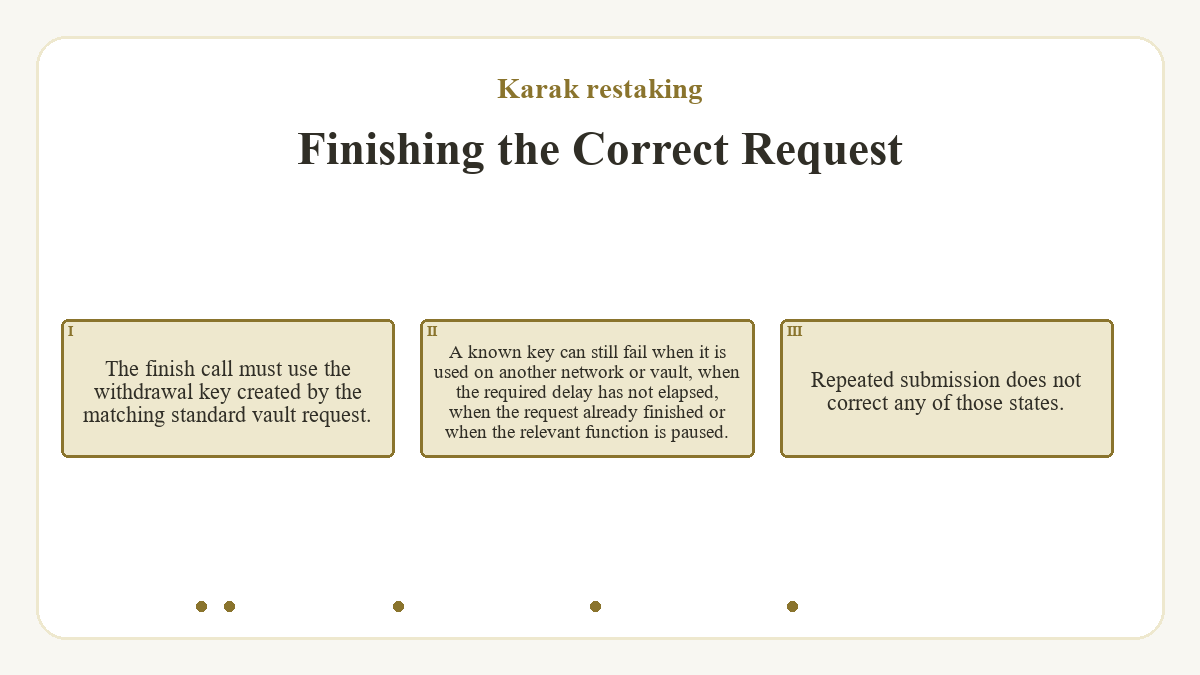
The finish call must use the withdrawal key created by the matching standard vault request. A known key can still fail when it is used on another network or vault, when the required delay has not elapsed, when the request already finished or when the relevant function is paused. Repeated submission does not correct any of those states.
Completion evidence includes the finished-redemption event, burned shares and the underlying asset received by the recorded beneficiary. Check that beneficiary rather than only the transaction sender. A successful finish transaction followed by a stale portfolio entry is a display problem when the event and final balances already agree.
When Should You Retry or Stop?
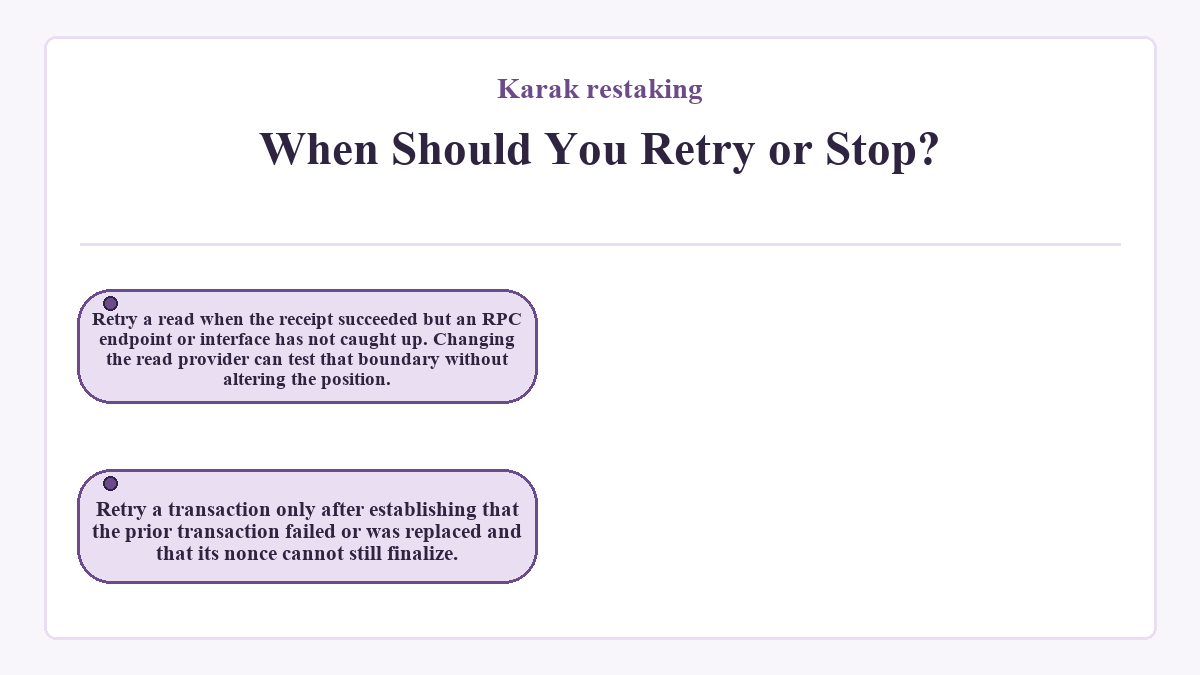
Retry a read when the receipt succeeded but an RPC endpoint or interface has not caught up. Changing the read provider can test that boundary without altering the position. Retry a transaction only after establishing that the prior transaction failed or was replaced and that its nonce cannot still finalize.
Stop before signing when the wallet switches to an unexpected network, the spender differs from the selected vault or the recipient is unfamiliar. Also stop when a migration or withdrawal record cannot be matched to its originating receipt. Those mismatches require corrected context, not a larger allowance, a looser minimum output or another queued request.
Version, Migration and Route Boundaries
Legacy and V2 positions can use different contracts and state stores. The documented V1-to-V2 migration requires an allowlisted route and the same underlying asset in both vaults. When legacy shares are tokenized rather than held internally by the supervisor, they must first be returned to the required internal form for that migration path.
Custom vaults and native-restaking routes can expose requirements that differ from the standard ERC-20 vault flow. Identify the implementation before applying standard deposit or redemption assumptions. Before a direct migration, verify the implementation, network, old and destination vaults, underlying asset, share custody and route eligibility. If any prerequisite fails, treat the legacy and destination positions as separate paths rather than assuming automatic compatibility.
Karak restaking: what people ask
Is Gas Required When the Wallet Already Holds the Deposit Token?
Yes, each on-chain transaction requires the native gas asset used by the selected network. Holding the ERC-20 deposit asset does not pay for a separate approval, deposit, redemption start or redemption finish call. A wallet can therefore show enough deposit tokens while simulation or submission still fails for insufficient gas. Estimate gas in the exact network context because another network’s native balance is not available to the current transaction.
Can the Deposit Recipient Differ From the Connected Wallet?
Yes, the standard deposit call can mint vault shares to a recipient specified separately from the transaction sender. When a receipt succeeds but the connected wallet shows no shares, inspect the Deposit event and the mint Transfer event for that recipient. Query the recipient’s share balance directly before attempting another deposit. The transaction sender, asset owner and share recipient should not be assumed to be identical without reading the call and events.
Why Can an Asset Appear in One Network View but Not Another?
Asset and vault availability is deployment-specific, so support on one network does not establish support elsewhere. Each network has its own token addresses, Karak contracts, vaults and live controls. Match the asset contract and vault to the wallet’s selected network rather than relying on a symbol or a remembered availability list. If no compatible vault exists in that context, switching only the token address cannot create a supported route.
How Long Should I Wait Before Treating a Missing Portfolio Update as Failed?
A missing interface update has no universal failure deadline because transaction finality and indexing are separate processes. First read the receipt and confirm its status, events, recipient and block. If the receipt succeeded, query the relevant vault state and balance directly or through another read provider. An absent expected state change means that the intended vault action did not occur; matching contract state with a stale interface indicates delayed indexing and does not justify resubmission.
Is a V1 Position Automatically Usable in Every V2 Vault?
No, a documented direct migration requires an allowlisted route and matching underlying assets between the old and new vaults. Some legacy shares may also need to be returned to the supervisor’s internal accounting before migration. A V2 vault that accepts a similar-looking asset is not enough on its own. Confirm the exact old vault, destination vault, underlying asset and migration eligibility before treating the positions as compatible.
What Evidence Is Useful When a Karak Vault Call Reverts?
Preserve the transaction hash, network, block number, sender, vault address, method and available revert data. Also record the asset contract, allowance, input amount and expected recipient when they apply to the failed call. For a withdrawal, keep the withdrawal key, staker and nonce from the originating receipt. Never provide a seed phrase, private key or wallet backup because none of those secrets is required to inspect public transaction evidence.
Why Might finishRedeem Reject a Known Withdrawal Key?
A valid-looking withdrawal key can fail when it belongs to another network or vault, the live minimum delay has not elapsed, the request already finished or the function is paused. Match the key to the original StartedRedeem event and inspect the specific pending record before retrying. The key alone does not carry enough visible context to prove readiness, so the originating contract and current request state must agree.